Industry Patents
Patent: 5319301
Inductorless Controlled Transition and Other Light Dimmers
(Click image for PDF of full patent)
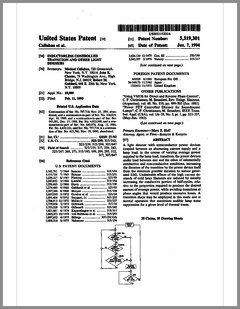
| Patent Number: |
5319301 |
| Title: |
Inductorless Controlled Transition and Other Light Dimmers |
| Abstract: |
A light dimmer with semiconductor power devices coupled between an
alternating current supply and a lamp load, in the course of varying
average power supplied to the lamp load, transitions the power devices
under load between one and the other of substantially conductive and
non-conductive conditions, increasing the duration of the transition by
the power device itself from the minimum possible duration to reduce
generated EMI. Undesirable effects of the high current demands of cold
lamp filaments are reduced by initially increasing the conductive portion
of half-cycles, relative to the proportion required to produce the desired
amount of average power, while avoiding transitions at phase angles that
would produce excessive losses. A transition shape may be employed in this
mode and in normal operation that maximizes audible lamp noise suppression
for a given level of thermal losses.
|
| Country of Issue: |
US |
| First Named Inventor: |
Callahan, Chester, Goddard |
| Assignee: |
|
| Continuation or Divisional of: |
4823069 |
| International Classification: |
G01N 27/82 |
| US Classification: |
323/235 |
| Issue Date: |
06-07-1994 |
| Filing Date: |
02-11-1993 |
| Application : |
18000 |
| Notes: |
|
| Link to Patent at freepatentsonline.com: |
5319301 at Freepatentsonline |
| Link to World Patent Family1: |
World Patent Family at European Patent Office |
| Link to Google Patents1: |
5319301 at Google Patents |
1. The Google Patents and World Patent Family links will likely not work until a few weeks
after the patent has issued - they take a while to get new patents in their systems.
Disclaimer: This web site is not intended to offer comprehensive or sufficient
information to enable a full legal analysis of a patent or potential
infringement. The information provided on this web site is intended
as general information only, and is not intended to serve as legal
opinion, legal advice or as a substitute for legal counsel. If you
have a question about a specific factual situation, you should
contact an attorney directly
|